
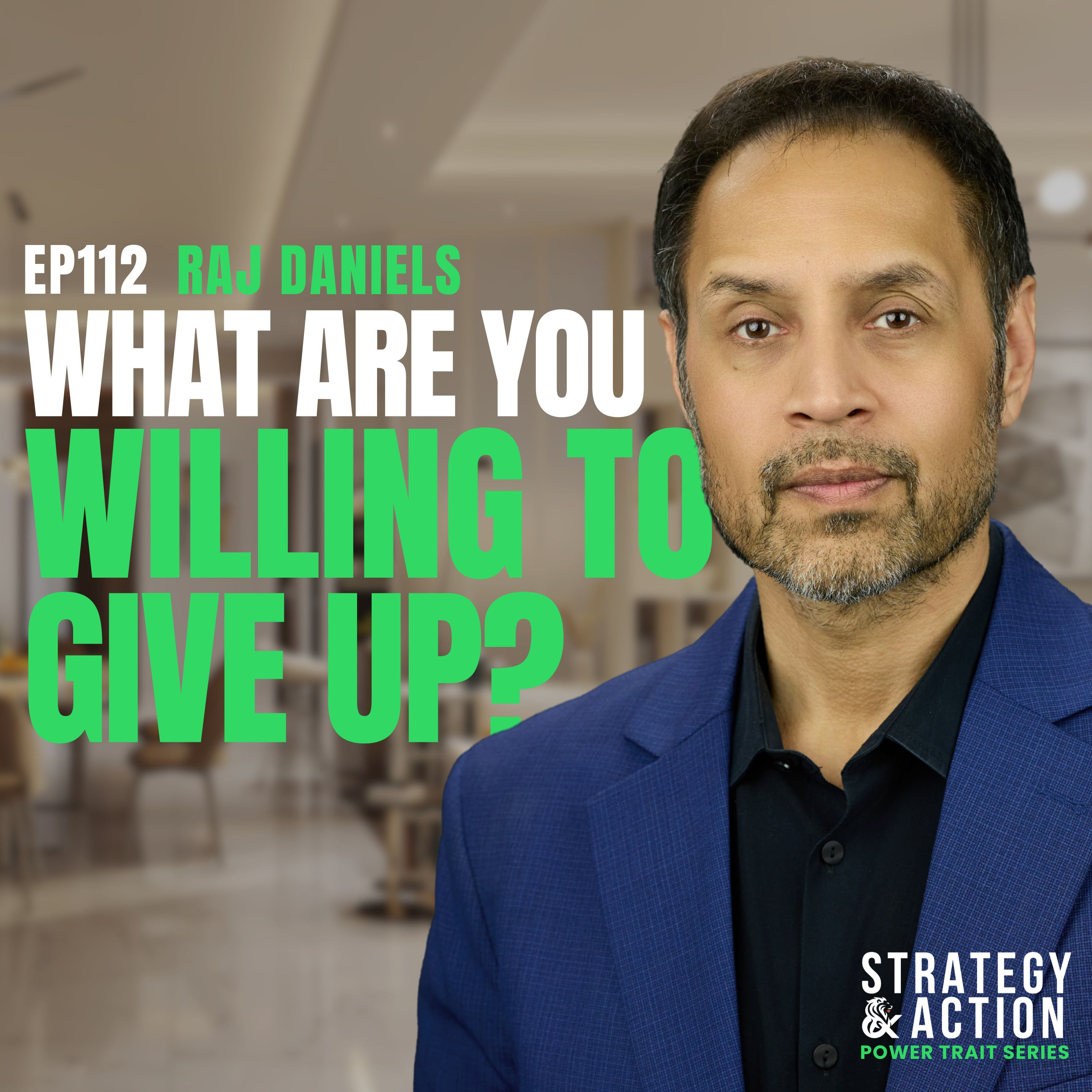
Ep112 Raj Daniels—The Power of Consistency: How to Build Lasting Success One Ordinary Day at a Time

 Apple Podcasts
 Spotify
 Castro
 RSS Feed
 In this standout installment of the Power Traits series on Strategy & Action, host Jason Croft sits down with the first person he thought of when designing this series: Raj Daniels. And once you hear this conversation, you'll understand exactly why.
Raj is the president of the US India Chamber of Commerce DFW, the largest Indian chamber in the nation. He's an author, entrepreneur, connector, and one of the most quietly powerful figures in the Dallas business community. But what Jason has watched up close for nearly a decade is something harder to put on a résumé—Raj's extraordinary ability to show up, day after day, without needing to see the finish line.
This episode goes far beyond surface-level advice about discipline and habits. Raj opens with a surprisingly personal origin story about a 260-pound turning point in front of a gym mirror, wearing jams and a Spuds McKenzie shirt, and explains how that moment became the foundation for a consistency-driven identity that has shaped everything since. From writing over 1,000 blog posts that quietly led to a book deal, speaking engagements, and paying clients to running an eight-year unpaid newsletter that became the second most-read tech newsletter in DFW, Raj is a living case study in what compounding effort actually looks like over time.
Jason brings his signature thoughtfulness and firsthand perspective to the conversation, pressing Raj on the real costs of consistency, the challenge of leaving certain relationships behind, and what it truly means to be directionally correct when you cannot yet see where you are headed.
Here is what listeners will take away from this episode:
• How to identify what you must intentionally sacrifice in order to make room for a new habit — the critical step most people completely overlook before starting anything new
• Why your capacity to endure boredom is the real denominator behind every long-term success, from weight loss and financial growth to lasting relationships and business momentum
• How to stay directionally correct when results are not yet visible and doubt starts to creep in
• Why the people currently in your life may be the single greatest obstacle standing between you and meaningful change and how to navigate that honestly and compassionately
• How consistent, non-transactional effort in content, community, and connection builds a reputation and a network that no algorithm or trend can take away
Whether you are launching a business, building an audience, developing a new skill, or simply trying to become a more disciplined version of yourself, Raj Daniels offers a grounded, battle-tested framework for making consistency not just a goal but a permanent part of who you are.
Raj Daniels 0:00
When you're trying to adopt a new lifestyle, a new pattern, something new in your life, you have to make room for it. And what I mean is that you have to sacrifice something if you want to start working out early in the morning, you have to either sacrifice sleep or going to work late or doing whatever that might be. And if you don't make that intentional room for that activity, you're going to smother that activity before it even begins.
Jason Croft 0:20
Welcome to strategy in action, where we reveal how industry leaders build real market gravity, the force that naturally attracts opportunities, partnerships and profits. You get raw insights, proven frameworks and strategies that actually move the needle in your business. Let's get started. Raj Daniels is on the show today, and he is my next talk in this power traits series that I'm doing. He's a dear friend. We've known each other for, gosh, a decade now, at least back from my startup Dallas. Days there the first show I ever did, and that amazing community, getting to know Raj and being at Big D OCC every Tuesday morning for so many years was such a blast. And his power trait is consistency. I'll venture to say he has multiple power traits for sure, and you'll see a lot of them, like connection and intentionality and thoughtfulness, but the one we focus on today is this idea of consistency. And honestly, Raj is the first person I thought of when I was going to do this power trait series, because it's this, it's the skill that I've seen him have and execute on in so many different endeavors, from writing to podcasting to business, and it's so powerful. And like with my buddy, well, who his power trait being rigor, right? I see these power traits in in folks so much because I feel like I lack them. I see the value in them, in work towards doing a little better with those. And Raj is definitely an aspect of that, that idea of consistency and being so purposeful to day in and day out do something that you've committed to, either directionally or as an end goal. It's so powerful, and it's the key to success in anything, and it's one of the harder things to do, because we can't always see where is this going. Why am I doing this again, day in and day out, and to keep doing that over and over. So you even have the opportunity to look up a year from now, 10 years from now, and go, ah, that's why I was doing it. Or, ah, look what we've done. Because I did this every day for the last 10 years or every week, whatever that may be. So powerful conversation. Raj is an amazing human being, and you'll see that and feel that in this episode for sure. All right, let's jump in. Raj, Daniels, my friend, welcome back to the show.
Raj Daniels 3:31
Jason, great to see you.
Jason Croft 3:34
Oh, this is so fun. This has been a long time coming, both in this particular episode and what we're talking about here, but also just having you back on the show from episode one to now, 100 plus. It's about time that Raj is back on the show.
Raj Daniels 3:52
Episode one to 100 plus. Previously, what was it called? In cars? Entrepreneurs in cars. What were we call
Speaker 1 4:01
it
Jason Croft 4:02
was the Jason Croft show.
Raj Daniels 4:03
Jason Croft show that's right in the car. That's
Jason Croft 4:07
right episode one of that,
Jason Croft 4:08
and prior to that, the studio.
Jason Croft 4:11
That's right. Startup Dallas,
Raj Daniels 4:13
yes, sir.
Jason Croft 4:13
Well, I want to set this up for folks certainly to have you on so many reasons. I mean, we used to talk every week, and we did. We could certainly talk and have you on the show every week just to talk about life and the world, and it would be amazing. But this particular conversation, I wanted to have you on in this power treats series that I've been doing, because you're one of those people that I identified when I first thought of this series as having this core trait that I see over and over again, and for you, it's consistency. And if anybody's tried to accomplish anything in life, whether they use it or not, they know that. That real, true consistency is so powerful. I mean, it's the secret behind compound interest, right? Like it's, it's that aspect of things to have that patience and to not just wait, but have the patience and do over and over and over and over again, and I want to dig in for folks. They know what you've got going on here are, but I really want to have this conversation, because I have seen it firsthand in you, this superpower of consistency from writing to podcasting to business. And really get from you how you've seen that and why it's there, and what that's brought about in your world because of it. But right now, today, I know we have our history back in startup days in the Dallas world for sure, if you've done so much. And right now, your current role, as in the US India Chamber of Commerce, running that like, what that's so so amazing. And it's being president of that. It's so fitting, such a great role. Because, yes, we're going to talk a lot about consistency today, but also you were an amazing connector, and putting people and pieces together that that role makes so much sense. So biggest opening, giant question intro in the history of podcast, I'll let you talk now. We have about three minutes left. You can talk, but Yeah, jump in. Tell us what's what's happening right now with your role there and and your other endeavors.
Raj Daniels 6:47
So yes, currently serve, have the pleasure, the humility to serve as the president of the US India Chamber of Commerce, DFW, it's the largest Indian chamber in the nation. We have over 200 member companies. I like to say we punch above our body weight, because when I say member companies, it could be, you know, a small it operation with a few employees all the way through to DFW airport, New York Life, Southwest Airlines and many other enterprises. So we probably have, we're probably able to connect with many 1000 people, you know, through our newsletters, through our events. Last year, we did over 15 events, four what I call major and then one is our capstone. So the major events usually get about 400 people in the room. It's a women's forum, forum, a tech forum, Health Forum, business expo, and then we did our annual awards banquet. Last year, we got over 800 people in the room. So in real life, we bring together over 2500 people, maybe even more than that. It's been a great experience. I've been there about a year and a half, maybe a little longer than that. Last year, we were able to grow the chamber membership by over 25 27% able to grow revenues in a similar fashion. But the most important part to me regarding that, and you know, going back to our days, and Jason, you brought this up, is the ability to get my arms around the community. You know, something you alluded to earlier about speaking every week we used to be part of or run, you know, the big Dallas open coffee club. Shout out, Michael and again, just being able to engage community, help community, provide value for community. And when I say community, because you've known me, it's not just the Indian community, it's across the board. You know, if I can bring two people together, I love my inbox. I can look at it the end of the week, or my outbox at the end of the week, and I say, you know, X person, meet y person. If I've done it many times throughout the week, I feel like I'm leading, you know, my purpose in why I'm here and doing what I'm doing.
Jason Croft 8:48
Oh yeah. He's such a master at it, and that it is such a purposeful skill, too. I think some of these things get categorized by by other people as just like, oh yeah. Raj is just great at that, well, he is, but he's also purposeful at that. He's intentional with that, and that's something I admire so much in you, is, is that that thoughtfulness about what you do and what you do includes bringing people together such a purposefulness in that, that that I just love. I want to make sure I've got this down also in 2025 listed by DCO CEO magazine. It's one of the 500 most influential people in Dallas. Are you kidding me? People believe stuff they read. I don't even know. I love that. I just host of a podcast bigger than us. Podcast taking a little break now with that, but that's come into play that's been so consistent. The book you wrote, The newsletter, big D, O, C, C, you ran, you had the newsletter for that weekly. How many years of that? Eight? Years, and just to make people aware, that's unpaid labor of love, eight years. In fact, I met someone last year at a meeting, and they're like, Are you the same Raj Daniels that used to write the big D OCC newsletter, so I've still run into subscribers. It became the second most read tech newsletter in DFW. Wow. Let's get into that. Specifically. Where do you think that comes from, that consistency, and when did you first lean into that and like, Oh, this is really important. I'm going to focus on that. So
Jason Croft 10:36
I'm
Raj Daniels 10:37
going to take a slightly different angle towards this question. You didn't know me 30 plus years ago, maybe a little longer, I used to weigh 260 pounds and had a 44 inch waist,
Jason Croft 10:53
wow. And
Raj Daniels 10:54
I remember the first time I walked into the gym, for those of you who were out there listening, I was wearing a pair of jams and a spuds McKenzie t shirt
Jason Croft 11:05
that
Jason Croft 11:05
puts the date perfectly into 260
Raj Daniels 11:06
ish pounds. And I said, this is not going to be me any longer. And I've been around hundreds of people over the last, you know, 30 odd years, who've lost weight? But do you know that the recidivism in weight loss is greater than drugs, alcohol, you name it, people gain the way back weight back, if not in a year, then two years, three years eventually. And so I took that example from there. For me, it's not about the weight loss, it's about every day the decision or the the identity of who I want to be. And so I align myself with a mantra that I have an identity of who I want to be. And every day I look at myself through that lens, and what I found I could do is that I could adopt that behavior for one part of my life, and I could apply it to other parts of my life. And it's interesting. You're bringing this up because I have three daughters, and I have this conversation with them quite often. Actually, on my website, I'm actually kind of out I'm noodling out loud on my website right now about your capacity to endure boredom is the denominator for everything, your capacity to endure, boredom, consistency is the denominator for a long term marriage, weight loss, saving money, you know, rinse and repeat, rinse and repeat, rinse and repeat. And what I found is that people want the new shiny. People want the get rich. People want the just add water overnight millionaire, you know, quick oats. I don't know what that is, but and one's ability to endure that continuously, and sometimes you have faith in your activity of what you're doing, but you don't have the attachments to the results. And so I'm noodling this out loud, but I feel like consistency, or perhaps it differently, is your ability to, you know,
Jason Croft 13:12
accept boredom as part of your life or part of the adventure that is the, I think, hand in hand, difficult piece of it that comes with consistency to get to a bigger goal. One piece is that boredom. That other piece you touched on is not knowing the am I doing, what I'm doing every single day? Going to get me to that, we could probably do a laundry list of what that takes both from judging the results along the way enough, but also having that voice, having the who's done it before, who's guiding, who's got the accountability not just to keep doing it, but am I doing the right thing if I'm practicing something the wrong way a million times, that doesn't make me good at it. It makes me proficient in doing something the wrong way. So how do you, as you pick this goal and you're going to do that, hey, this is something I'm going to do. Do you pick a certain amount of time when you go through that, and then how do you figure out milestones along the way?
Raj Daniels 14:20
So I think it depends on the Endeavor I do, some endeavors as laborers of love. You mentioned the big D OCC newsletter, which, which was, you know, just a labor of love that I did for eight years every Tuesday. And it led to people reaching out, people building my network. You know, some might say, Oh, it didn't lead to any financial goal. But I think we, you know, we've come too far to measure everything by a financial goal. It led to a network, it led to a community. It led to us being able to come together. My blog post, you know, you mentioned my writing earlier. I've published over 1000 blog posts. Two years into writing those blog posts, someone said you should write. A book. I'm going to give you a real specific journey here. Someone said you should write a book and do a compedium of your blog post. I said, why? They said, You know, we're enjoying them. I said, Okay, fair enough. So I published the book. You recall 2017 2018 I got called four different times to speak at organizations, and I did book signings. I didn't know the blog post was going to lead to read to a book, to read to a blog, to book signings, and then people hired me. Subsequently, after that, looking back, you can connect the dots, as they
Jason Croft 15:29
say,
Raj Daniels 15:30
looking forward, you can't. So sometimes you do these activities. Now, on the other hand, regarding, let's say, perhaps a financial goal or weight loss goal, or something along those lines. You know right now, you and I are sitting here as iterations of nature. We are proofs of evolution that some things went right, some things went right, some things went right, and here we are today. And so when it comes to perhaps a financial goal, or let's say, a goal at the Chamber membership goal, and you can track and say, Okay, what does that iteration look like? What happened? What did we learn? What can we do differently? How can we pivot slightly, but not too much? But, you know, I tell my the words I use my kids, and my kids get tired of hearing this is that kids, you need to be directionally correct, directionally correct. And that's what I tell myself to in that, you know, if I'm if I can see progress to some extent, and I can see that, okay, I can make a little bit of a pivot here. Perhaps this didn't work, not anything too drastic, right? And you've heard the adage so many times about, you know, an airplane is off track 80% of the time because it reached his goal, right? And so am I. But the like I said, the two different exercises I use, one is, let me just do this, see what happens. So think about blog. Think about blog. Think about big deal, CC, newsletter. And the other one is that, okay, I've got a financial goal, or, you know, a membership goal, that I'm really driving towards. What are we doing to iterate and make changes on the way to that? And how close can we come to that? I
Jason Croft 16:55
think those are two really distinct camps of what we're talking about. Certainly a second, when you talked about the goal aspect, we want to accomplish this, and that has those, those markers, and let's evaluate, okay, what did we do the last year? Are we directionally correct? Still? Does this make sense? It's almost the art and science, the two camps, right? It's like, that first one's more art. It's like, I don't know what this is, but this speaks to me. I'm gonna go this way, go this direction. I don't know what could lead to, but there's a fulfillment there. It becomes figuring out how to develop those skills, to trust yourself and to listen. And who do you surround yourself with? So that if you do have that Inkling the people around you go, yeah, you should do that. That'd be pretty cool. That becomes a bigger thing. I think you and I, both, we were so immersed in, well, the people and the knowledge of just getting better improving. That's our language. We talk about that. We talk to other people who are like that. If that is even foreign for folks, where do they start to even trust that Inkling a little bit and get directionally correct in something? Do you think
Raj Daniels 18:18
so? You know being around the startup scene for 1516, years now, I've seen that there's a question that I've heard so often that I think is to some extent, and obviously there's room for debate here is, how are you going to make money doing that? And I think of that question many times as a dream killer. I think people second guess themselves, and they don't allow themselves to just experiment. And I'm not saying, you know, jump in both feet or put everything on the line, but allow yourself to do a few little, small side experiments and then find your community. I can tell you till today I know a lot of my stuff that I might say sounds delusional, but I can tell you till today I know exactly when I was going to launch my startup. I was thinking about, who do I reach out to? What do I do? It was 2013 2014 timeframe, and I was pulling my car out the garage, and for some reason, I had NPR on, and there was a guy from the Dallas startup community named by the name of Bradley. I don't know if you remember him. Bradley Joyce, yep. Yeah, yeah. Bradley Joyce, photographer.
Jason Croft 19:30
Now, did you know
Raj Daniels 19:31
was on NPR that day? Just happened to be talking about the Dallas startup ecosystem?
Jason Croft 19:38
Wow.
Raj Daniels 19:39
So I know you know, if you if you seek, you will find there's that, there's a adage, but I'm a huge believer in that. And so whatever interest I have, a friend now. He's a mentor. Jim shields, runs shields Legal Group, and he said he has a sign on his desk that his father had on his desk, and it says, begin, and the rest is easy. And I don't. Believe the rest is easy, but begin is the hard part, right? Inertia and so whatever interest, whatever project, whatever you might be thinking about, just begin and begin with what you have at your fingertips. I still have the same website for the last 10 years that I've had because it's the one I know how to run, and people still visit that website. I have notebooks and pens and papers here. You don't need the new technology. You don't need. If I would just ask you, just now, let's go back to the weight loss thing. Jason, how do you lose weight? You'd probably come back with some answer of, you know, you eat less and work out more, right? You just begin with what you have, right? And so whatever that inkling that you have, if you can carve out 20 minutes, 30 minutes to trust yourself and start pursuing that as a passion, as an idea, as a project, with again, going back to not looking for a specific outcome, I think that's that biggest piece of you know begin, and the rest is easy.
Jason Croft 20:58
I've certainly erred on the other side, too, too much. Because I think there's, there's a piece of that. If you're going to go down this road, you're going to start a podcast, if you're going to start a new business, it's going to take so much because, yes, it's hard to start. The rest is not easy. It's going to take so much going down the road, I'm always quick with, okay, great. How are you going to keep this going? How? And a lot of times that is the revenue piece to how's it going to make money? Otherwise, it's not going to continue, right? But to your point. If you only have the lens through that and you don't have the exact answer how it's going to make money, you'll never you'll never get to that chance. You'll never get started. You'll never get down the road to find yourself three miles down and go, Oh, that's it, perfect. Now, I interacted with this person, or they asked for this. This is I had no idea. And I wouldn't have any idea if I was still back at square one, going, Hmm, let me think of all the ways this might work. So much of that you talk about getting directionally correct, and direction is forward sometimes, and then, oh yeah, you can veer off here and go there, but the amount of time spent in the garage thinking about, oh, one day I'll go somewhere, that's the that's the killer. And you know,
Raj Daniels 22:34
sometimes you're building a bank account, but sometimes you're building a reputation. When I was running the podcast actively in 2023 and 2024 specifically in the Arts and Science category, the bigger than this podcast beat BBC in five markets. And it's just, it's, it's me burning the podcast from here and BBC with their entire production studio. And I can guarantee you when I reach out to my next guest, who's the CEO of whatever company that might be, he or she'll look at that and say, Absolutely, I'd love to be on your show, because I built a reputation, or, you know, I had built the catalog of 150 or 170 episodes, and people see the who's and who that's been on there, and then I've done what in certain markets.
Jason Croft 23:17
That's an interesting point, too. What are those activities that you can do when you don't yet know exactly what you want to go and do. And I think a lot of these that you've done, some that I've done, are these great reputation building, but also just relationship building activities if you don't quite know. I don't know if I want to start a business. I don't know if I want to do this. I don't. But generally, back to that, that first bucket, that art bucket, is there's something speaking to me in this world. When you go and start a Newsletter from Scratch in that world, or a podcast, and you start meeting people, or your local meetup group and just start showing up. That's when those things it gets the juices, but you get immersed in that world and and now, like with the bigger than us, podcast for you, let's say something comes down the pipe tomorrow, this opportunity to have an investment, or whatever that might be, or, oh, I need to introduce this person and that person. And there's a big piece for you, if it comes, and now you've got this database of who to go to and either put people together, or, Oh, wow, Bill, who was running that organization, he'll know exactly what I should do and all of those things, they are prescriptive. You can't sit down and here's the plan to go and do all of that, but all of these things with this consistency aspect, all. Lead to be able to look back and see, oh, this is how they all connected. And that's hard to give advice. But just happened last week, last Friday afternoon, previous Friday, we were in a meeting with the earth X group here in Dallas, and I met the new CEO of the earth X group. His name is Peter, and he was asking about, who do we know that could be good potential speakers? And I said, go look through the catalog of bigger than us. There's someone there that you think would be interesting. Let me know. I'm
Raj Daniels 25:30
happy to make that
Jason Croft 25:31
introduction. And that's and that's a win on both sides. It's not just like, oh Earth. X wins because they get to talk well, the other person gets to be highlighted there. It's just, it's beautiful. And I love those real life tangible examples of that too. I remember back, I get back back then in those days I used to, I used to keep track of it, of oh, I introduced this person to this person, and this is what happened. I mean, it got it got away from me, really, really, really quickly to keep up with it, but that was it. I kept track of it because it was so much joy like that was so fulfilling to connect people. And now something new is off in the world, because these two people got introduced. I love that stuff. Maybe it's on the second bucket. And if you don't know, you've got this goal in mind, you hear it all the time, consistency, consistency. What do I do consistently? How do we help people kind of break that down? They've got this milestone goal. They want to reach this into this idea, to even let in the fact that, oh, I need to be consistent with it, and you do it. But how do I even know what to do?
Raj Daniels 26:46
Fortunately, we live in a world where information is abundant, and I think to some extent, we're spoiled for choice. I loved, I love reading biographies of people from 100 years ago. And it could be, you know, the industrialists, the carnegies of the world, the Vanderbilts of the world. Most recently, I finished what I consider to be an amazing biography of Mark Twain, you know, still, 100 years later, is considered America's author. And you think back to a time where he was writing longhand on legal pads, all his writing, until the typewriter came along, you know. And so I think it's not complicated about where to start and how to start. I think it's the starting come back to starting. But I also think, you know, we've touched on it too, about surrounding yourself with people that are on a similar journey. I think is really important. We talk about the startup ecosystem. Here, we talk about the podcast ecosystem, but surrounding yourself with people who are on a similar journey. The challenging part about that, and I've experienced this in my life a few times, is that you will have to leave some people behind. Many times, people can't appreciate that, or can't accept that. If you're let's go to the weight loss again. If you're trying to lose weight, you don't want to be in a bar every night eating fast food.
Jason Croft 28:09
If you're
Raj Daniels 28:10
trying to quit drinking, you don't want to be going out to happy hour with your friends. You know, if you're trying to set off on a new journey, there are only a few people that are going to go on that journey with you. The left of the left of the rest of you to leave behind, tell me you don't love them anymore. I had friends of mine that I've known for 3040, years, who I still keep in touch with once in a while, but we've all gone different directions. You know, we want different things out of life, and so if someone is really committed to an endeavor, they're going to have to take time to, and I'm going to use this word, it may not be the correct word, they're going to have to take time to, perhaps, mourn their relationship, and come to that person and say, hey, look, this is what I'm trying to do. This where I want to go, I would love your support, but, if not, I love you, but I need to go do this. You know, there's a lot of talk about habits and new habits and how to and again, a lot of this stuff I'm going to share with you, I tell my girls, I said, one of the things that people neglect to realize is that when you're trying to adopt a new lifestyle, a new pattern, something new in your life, you have to make room for it. And what that means that you have to sacrifice something if you want to start working out early in the morning, you have to either sacrifice sleep or going to work late or doing whatever that might be. If you're, you know, trying to write, you have to sacrifice, there's 168 hours in a week. You have to pick where you're going to sacrifice, what you're going to do. And if you don't make that intentional room for that activity, you're going to smother that activity before it even begins. And so, taking that intentional step, what am I going to sacrifice in order to go down this journey, in order to adopt this new habit, this new routine, I think is a really important part that I see people skip over all the time. You know, in December, they have that conversation about, I'm going to start going to the gym in January. And I asked them, What are you going to give up? And eyes go big, what do you mean? What am I. Gonna give up. Well, I mean, you don't go right now. You need an hour to go. What? What are you gonna do with that hour? Is it one less time with your kids, your wife, your work, your you know, your sleep? Where's it gonna come from? And so I think that's a really important part about as they started on that journey, what am I gonna mourn? What am I gonna give up?
Jason Croft 30:17
It sounds obvious when you sit there and we have this conversation like this, and you Well, yeah, of course you have to get a but so few of us do it. So few of us get intentional. Because even if, in best case scenario, you have the willpower to power through and you're you do keep up with that habit, but you weren't intentional with what you're going to give up, well, then something's going to fall off that maybe you didn't want to fall off because you're powering through. So either way, if you're going to keep up with it, or if you want to stay in control of it, sit down and just coming to terms with it, realizing, okay, I do have to give up something with that. And I know, for for some folks, whether it's extended family or their friend group, they couldn't imagine, you know, walking away or spending less time with those folks in order to accomplish that, and that is such a massive driver to stay stuck in that cycle. I mean, I don't know. Maybe it's just different personality types. I think it's a combo of that's an easier thing for me. Always has been. I don't know why. Maybe there's something wrong with me, but that's an easier thing to break off when necessary. But it's also, gosh. I mean, most of my life I have been around those folks who are, oh, yeah, oh, that's awesome. You're doing that. Oh, that's super cool. And I'm haven't been surrounded with people who are, oh, that's stupid, right, you know, and all that negative talk. So I haven't had to bust out of it either. I think it's a great way to frame that. I appreciate that answer so much that it is. It's less about what do I do? It's how am I going to go execute on what I need to do day in and day out. That's strong
Jason Croft 32:12
if
Raj Daniels 32:12
you think about let's just use an exaggerated example. If someone's planning to go climb Everest, they don't take their best friends. They find the best Sherpas, the best guides, right? People that have kind of done that before. So like, Hey, Jason, I'm going to count Everest. You're going to come, come with me if I think nothing against you.
Jason Croft 32:27
Yeah. But even if they they do go find the Sherpa stuff, they also don't bring their friends along. Their friends who have never done anything and have no interest in going to Everest, they're trying to drag them along. Do you think there's a downside to that consistency that you've had at all
Raj Daniels 32:42
100% there always is. And I mean, it could be something as simple as I go to bed 930 10pm my kids are still awake. I miss time with them in the evenings. But am I willing to sacrifice not waking up at five, 530 in the morning, meditating, going to the gym, doing those things, because I know those things make me a better person, and allow me as a father, to show up better for them. Or, you know, is it perhaps I don't attend a certain event, or I don't do a certain thing because I wanted to be doing something else in my time? So absolutely a downside. Now, I think it depends also you measure a down downside. I don't have that FOMO gene. Fortunately. In fact, I was joking with a friend recently. I have that Jomo gene. You know the joy of missing out. Wait, I wasn't invited. Oh, my word. Oh no, you know. So I have more of that, which is sometimes a point of contention in my marriage. But you know what? My wife knows me now. We're 20 years in this year, so she knows, you know, when the events I want to go to and don't want to go to. So we've kind of come to that understanding. But, yeah, I mean, you know, I have a genetic predisposition to doing what I like to do and getting done what I like to get done.
Jason Croft 33:52
You think this was there? I mean, you mentioned that that weight loss journey, where that first showed up, you see it as as a kid, even back, any little consistency that maybe the Inkling, and you think that was really a pivotal moment,
Raj Daniels 34:06
that's a great question. And I've come to terms with this is that I think I spend more of my time today trying to remember. I know the memory is not reliable, but who I was between, you know, let's say between the ages of five and 10 or 12, who I was, who I really was, versus where and how I grew up. And I'll make this tangible so you can maybe get your brain around this. I grew up in southeast London, which is one of the toughest areas in London to grow up around. Violence became necessary on a regular basis, going to school, being Indian, there's a lot of prejudice, racism. So I knew who I wanted to be on the inside, but that version of me wasn't allowed to exist externally in that environment, and so I had to put on a lot. Of masks, if you will, or, you know, uniforms of who I had to be to exist in that particular environment. And so I found myself, and I found other people like this too, who have who are spending a lot of their adulthood trying to revert back to the person they were when they were formative children. And so going back to that consistency piece, if you ask me, like, you know, when I was five, 710, years old, what did I enjoy doing? I enjoyed doing puzzles. I enjoyed and I'm going to say this, I think statute of limitations over. I enjoyed picking locks, right? I enjoyed I enjoyed focused activity for extended durations of time. I didn't care what was going on if I'm focused on something, just leave me alone. Let me get to it. And I see myself leaning more and more into that. So I do think there's some disposition to that. Now, having three daughters, different kinds of daughters, I see there are different genetic makeups, and I know the ones that can focus for extended amount of time and perhaps the one that can't but, you know, I see more of myself and who I would have been in a different environment, and perhaps working my way to be more of that person.
Jason Croft 36:10
Wow, I love that. Yeah. Isn't it fascinating? I think there's a good mix of identifying that, getting back to that, because there's a reason. There's a it's something that's at the core of who we are and also evolving. It's not that, you know, I really need to get back to picking locks. You know,
Jason Croft 36:28
it's a
Raj Daniels 36:28
different version of picking locks. A goal is a puzzle to be solved to me. And so that's the way I look at it. Is that, okay, this is a goal we have. How can we break it down to, you know, smallest parts, and how can we solve it? To me, it's the same, it's the same mentality of doing any kind of puzzle.
Jason Croft 36:43
Oh, yeah, that's perfect. People are puzzles. And how do we get these people to work together? And what's that unlock there thing that's fantastic. How do we use that strength in a way so that it's, you know, you know, it's not a detriment to you, but you play to that strength. I love this, and I think should be pretty obvious to folks why I wanted to have this conversation with you. Appreciate
Raj Daniels 37:08
you. Jason rallies,
Jason Croft 37:10
oh, well, likewise, my friend. And this is this is awesome. How do people reach out to you and who should reach out in this day and age, in this current version of Raj Daniels,
Raj Daniels 37:21
I have a superpower and a weakness, two sides of the same coin. I'll take one call or one meeting with anyone. Go to my website, Raj daniels.com, there's a form right there. I still get inbounds. I still answer them all. I still take calls. I still take meetings. LinkedIn, obviously, feel free to reach out. I you'll see what my website's been there for 10 years. No transaction, no agenda. Let's just have a phone call or conversation like two human
Jason Croft 37:44
beings.
Jason Croft 37:45
Fantastic. Raj, thank you so much for being
Jason Croft 37:48
on
Raj Daniels 37:48
appreciate you, Jason, always.
Jason Croft 37:51
Thanks for joining us on strategy in action. Remember true industry leaders don't chase opportunities. They attract them. Want to build your own market gravity, visit media leads co.com See you next time you.

President
Raj Daniels is the President of the US-India Chamber of Commerce in Dallas, Texas. As an executive advisor, strategist, and consultant, he brings decades of experience helping businesses grow and succeed across the Dallas-Fort Worth region and beyond. Raj specializes in leadership development, business growth, and building long-term strategic relationships that empower executives and entrepreneurs to achieve lasting success.
He is deeply committed to community service and civic engagement. Raj serves on the Library Board for the City of Carrollton, the Steering Council for Hunger Mitao, and the Board of Directors for the World Affairs Council of Dallas/Fort Worth—where he supports efforts to expand global awareness and dialogue in the region. In 2025, Raj was listed by DCEO Magazine as one of the 500 most influential executives in North Texas.
Raj is also the author of For You, From Me, the host of the Bigger Than Us podcast, and a prolific blogger, having authored over 1,000 posts focused on personal development, leadership, and purpose-driven work.
He holds a Bachelor’s degree in Interdisciplinary Studies from the University of North Texas and an MBA in Global Leadership from the University of Texas at Dallas.